Stage 3 - Safeguarding Plan and Review
11. Safeguarding Plan
11.1 What is a safeguarding plan?
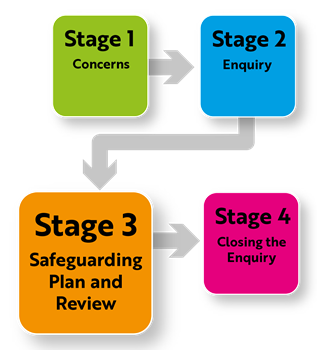
A safeguarding plan is the agreed set of actions and strategies that are designed to support and manage ongoing risk of abuse or neglect for an adult with care and support needs.
The purpose of an adult safeguarding plan is to formalise and coordinate the range of actions to protect the adult, and to support the adult to recover from the experience of abuse or neglect. Adult safeguarding plans should be individual, person-centred and outcome focused.
In relation to the adult this should set out:
- what steps are to be taken to assure their safety in future.
- the provision of any support, treatment or therapy including on-going advocacy.
- any modifications needed in the way services are provided (e.g., same gender care or placement; appointment of an OPG deputy);
- how best to support the adult through any action they take to seek justice or redress.
- any on-going risk management strategy as appropriate; and,
- any action to be taken in relation to the person or organisation that has caused the concern.
11.1 What is a safeguarding plan? - read more
The Local Authority will take responsibility for organising and coordinating the formulation of the adult safeguarding plan.
Care Act statutory guidance does not specify who or which agency should be responsible for monitoring and reviewing adult safeguarding plans. However, for all adult safeguarding plans, a lead professional should be identified who will monitor and review the plan. In most cases this will be the Responsible Manager from the Local Authority.
The adult safeguarding plan should identify who is involved in the plan and outline individual roles and responsibilities in relation to the plan.
The adult safeguarding plan should follow naturally from concluding the adult safeguarding enquiry and decisions on what actions are required in the adult’s case. There should be no delay between concluding the enquiry and formulating the plan.
A safeguarding plan should be formulated within 28 days, the same timescale for the enquiry to be completed.
Timescales for monitoring and review of the plan should be set individually when formulating the plan and should reflect the circumstances and level of risk involved.
The purpose of reviewing a safeguarding plan would be to:
- Evaluate the effectiveness of the safeguarding plan.
- Evaluate whether the plan is continuing to meet / achieve the adult’s outcomes.
- Evaluate levels of current and ongoing risk.
A Safeguarding Plan can be reviewed as often as required until the plan no longer requires review, is no longer needed, or the actions within the plan can be incorporated into other care and support processes. Within 3 months the actions within safeguarding plan review would generally be incorporated into the care and support plan if these actions are still required.
Be aware: if further safeguarding concerns come to light during the safeguarding plan review, then a new safeguarding concern / enquiry may need to be instigated.
Adult safeguarding plans should be made with the full participation of the adult, or their representative or advocate as appropriate. Wherever possible, adult safeguarding plans should be designed to reflect and aim to achieve the desired outcomes of the adult.
Adult safeguarding plans should not be paternalistic or risk averse. Plans should reflect a positive risk-taking approach and be clear how the plan will promote the wellbeing of the adult.
Where actions in the safeguarding plan are about them. The adult needs to consent to the actions within the safeguarding plan, or, if they lack capacity, the actions need to be in their best interests. Legal advice should be sought if there is a dispute that cannot be resolved or if there is an objection from the adult.
11.2 Multi-Agency Adult Safeguarding Meeting
When the enquiry is reaching its conclusion a multi-agency safeguarding meeting may be required. The overarching purpose of a Multi-Agency Adult Safeguarding Meeting is to bring together all of the relevant stakeholders, so that information and intelligence can be shared to determine what the appropriate actions should be to “sufficiently reduce or remove the risk to the adult” (although it may also be appropriate for this to 'remain' in some circumstances).
This is a shift in terminology and emphasis away from trying to 'substantiate' reports of abuse, which can become combative between professionals and agencies, detracting from the efforts to improve the adult's wellbeing and safety.
The Safeguarding meeting will also consider and review the safeguarding plan in place.
11.3 When might a Multi-Agency Adult Safeguarding Meeting be needed?
A Safeguarding Meeting may not be necessary in relation to all Section 42 Safeguarding Enquiries, but the following points should be used to help determine if one is required:
- Where the health and safety of the adult is, or maybe compromised, and a detailed (or initial) safeguarding plan is required.
- Where there have been previous Safeguarding Concerns and the issues have been repeated, and or, the risks are more acute than previously thought.
- Where multiple agencies (including providers) are needed in providing support and or protection, and there is a need to co-ordinate actions.
- In organisational or institutional cases where other adults are at risk of abuse or neglect. This may include where issues have affected residents of other Local Authorities.
- Where the abuse involved a member of staff/volunteer (position of trust), and this brings into question the safety of other adults, and or the service.
- Where there is the potential for parallel or overlapping criminal investigations by Police. In some instances, a Safeguarding Meeting may be required at short notice (1 day) following on from the Safeguarding Enquiries, if the issues identified place the adult at significant risk of harm, otherwise this should be arranged within 5working days of a decision being made that one is necessary. With this in mind the following points made under each of the six Safeguarding Principles should be followed to ensure that Safeguarding Meetings are utilised effectively and consistently.
|
Safeguarding Principle - Empowerment
What does this mean for the professionals: Adults are encouraged to make their own decisions and are provided with support and information.
What does this mean for the adult: "I am consulted about the outcomes I want from the safeguarding process and these directly inform what happens".
|
The Team Manager (or the person they have delegated to) who is setting up and chairing a Safeguarding Meeting must ensure that the adult’s views, wishes and opinions are effectively represented, and conduct the meeting in an appropriate manner, using appropriate adaptations if required, allowing for the full participation of the adult and or their representative(s).
If the adult does wish to attend the following points must be born in mind:
- The adult can bring someone to support them at the meeting. This might be a family member, friend or an Advocate. The chair should be notified if the person wants to bring someone to support them so this can be considered. The chair will make the final decision around who should be in attendance at the meeting.
- The meeting is about the adult and their views and wishes. The Chair of the meeting must ensure these are heard and listened to by everyone else.
- The meeting may need to decide what actions need to be taken, and by who, to make the adult safer and improve their wellbeing. This will be a group decision, and the adult’s views will form part of this decision.
- A Safeguarding Plan may be agreed - this is about how the adult wants to be supported to be safe. Decisions about the adult’s welfare or care will need to be agreed with them.
- If the adult has been assessed as not having mental capacity to make a particular decision at that time, then it will need to be made in their ‘best interests’, and their views, wishes, feelings and beliefs must still be taken into account. Such decisions must be made in line with the Mental Capacity Act 2005 (Mental capacity should be carefully considered during every safeguarding enquiry
If the adult does not wish to attend they may:
- Give their views in writing, or
- Ask someone to attend on their behalf, for example an advocate, friend or family member, or
- Ask the Safeguarding social worker or Manager overseeing the enquiry to pass on their views.
Local Government Association - Making Safeguarding Personal Toolkit : https://www.local.gov.uk/msp-toolkit
|
Safeguarding Principle - Prevention
What dies this mean for the professionals: Strategies are developed to prevent abuse and neglect that promotes resilience and self-determination.
What does this mean for the adult: "I am provided with easily understood information about what abuse is, how to recognise the signs and what I can do to seek help".
|
11.4 What the Safeguarding Meeting should consider?
- The longer-term ongoing support the adult will need
- What learning can be shared across agencies to help prevent further re-occurrences. This is also linked to Section 44 of the Care Act 2014 - if the criteria for a Safeguarding Adults Review (SAR) is met.
- What training or education is needed to help prevent further re-occurrences of abuse.
- How information should be recorded and shared in line with the data protection legislation to help prevent further instances of abuse
|
Safeguarding Principle - Proportionality
What does this mean for the professionals: A proportionate and least intrusive response is made balanced with the level of risk.
What does this mean for the adult: "I am confident professionals will work in my interest and only get involved as much as needed".
|
- If the abuse or neglect is unintentional and has arisen because an informal carer is struggling to care for another person. An assessment of both the carer and the adult must be considered in relation to wellbeing principles and duties.
|
Safeguarding Principle - Protection
What does this mean for the professionals: Adults are offered ways to protect themselves, and there is a co-ordinated response to safeguarding.
What does this mean for the adult: "I am provided with help and support to report abuse. I am supported to take part to the extent to which I want and to which I am able”.
|
- The details of the Safeguarding Concern and how this places the adult at risk of abuse or neglect.
- That there is clarity about the type of abuse that has occurred and that this is recorded effectively, considering types of abuse that are particularly under-recorded:
- Organisational Abuse
- Discriminatory Abuse
- Modern Slavery
- Domestic Abuse.
- How a Safeguarding Plan will be delivered to reduce or remove the risk of harm to the adult, and or others.
- Any potential risks to children and young people (or other adults at risk) and agreement on who will arrange a Child Protection referral, where necessary.
- The link with other key processes and procedures e.g., personnel issues (including referrals to the Disclosure and Barring Service or a professional or regulatory body); Police investigations; other regulatory processes such as PSIRF.
|
Safeguarding Principle - Partnerships
What does this mean for the professionals: Local solutions through services working together within their communities.
What does this mean for the adult: "I am confident that information will be appropriately shared in a way that takes into account its personal and sensitive nature. I am confident that agencies will work together to find the most effective responses for my own situation”.
|
- How everyone involved in the enquiry will deliver the actions that are agreed as a result of the enquiry in a manner consistent with Making Safeguarding Personal principles (MSP) and that the adult’s views and wishes are achieved as agreed.
|
Safeguarding Principle - Accountability
What does this mean for the professionals: Accountability and transparency in delivering a safeguarding response.
What does this mean for the adult: "I am clear about the roles and responsibilities of all those involved in the solution to the problem”.
|
- That arrangements are in place to give feedback to the person raising the Safeguarding Concern if they are not in attendance at the Safeguarding Meeting.
- How partners are going to monitor and measure the delivery of the agreed actions with MSP in mind.
- Issues relating to inequalities and or potential discrimination are identified and taken account of.
11.5 Who can convene a Multi-Agency Adult Safeguarding Meeting?
The Local Authority can convene a Multi-Agency Adult Safeguarding Meeting.
11.6. Who should attend a Multi-Agency Adult Safeguarding Meeting?
There are a wide range of people who may be required to attend a Safeguarding Meeting, including, but not limited to:
- The adult and or their representative (see 2.1).
- The Team Manager / senior practitioner or their equivalent.
- The Safeguarding Enquiry Officer usually the allocated social worker
- The person who raised the Safeguarding Concern (if they are a professional).
- Police manager.
- Other criminal justice agencies.
- NHS Trust manager and or relevant specialist.
- GP
- Care Quality Commission.
- Care Provider agency manager.
- Relevant Liverpool City Council or Integrated Care Board (ICB) Commissioner.
- Quality Assurance or Contracts Officer from Liverpool city Council or Liverpool Place - ICB.
- The person/agency alleged to have caused the harm should have been given the opportunity to submit their representations. If this an agency, then a manager not directly involved in providing care in the case may be invited to attend.
- Any other relevant agency/service representative as deemed appropriate by the person chairing the meeting.
Whoever attends a Safeguarding Meeting should be of sufficient seniority to make decisions within the meeting concerning the organisation’s role and the resources they may contribute to the agreed Safeguarding Plan.
Safeguarding Meetings can be formally recorded and minutes taken, which should be shared with those attending. When minutes are taken these should be completed within 5 working days of the Meeting.
Where it is not possible for a minute taker to be arranged then action notes should be taken this will be especially relevant to those enquiries that are less complex but so still require a Safeguarding meeting.
11.7 Practical arrangements
Whilst there is a need to formally record the minutes from Safeguarding Meetings, these should be set up as informally and flexibly as possible to meet the requirements of the adult and or their representative(s), whilst also helping ensure that professionals can contribute when these meetings are being set up at relatively short-notice.
It may be suitable and appropriate to set these meetings up online using video methods, or via telephone, or by being flexible in utilising meeting rooms that are accessible for those involved. Otherwise the chair of the Safeguarding Meeting should consider:
- How to create a comfortable and welcoming environment.
- Whether the adult wishes to have a representative(s) with them and whether they will or should have an active or silent role. The chair should be notified if the person wants to bring someone to support them so this can be considered. The chair will make the final decision around who should be in attendance at the meeting.
- Any communication requirements or other accessibility issues.
- Location of facilities such as refreshments and toilets.
- How breaks will be agreed, if needed.
- Arrangements should the adult require a break or wish to clarify any points covered in the meeting.
- The adult and their representative(s) should not be required to join a room where other attendees have previously gathered, and where possible they should be in the room before other attendees join, having met and had a chance to talk with the chair ahead of the meeting.
- Meetings can also be in multiple parts to make them less intimidating (smaller groups), more manageable for the adult, and include a separate and wider ‘professionals’ meeting.
Where the venue is the adult’s own home, consideration should be given to how their home will be treated with respect.
11.8 Feedback to family members
Depending on the circumstances it may be necessary to discuss the findings and the outcome with family members so that they are equipped with the relevant information to develop or be part of safeguarding plans.
- it may not be appropriate to disclose who raised the safeguarding concern
- it is not appropriate to disclose that the concern was raised by a whistle blower. Any staff/former member who is acting within a whistleblowing capacity will be referred to as an anonymous referrer to ensure their identity is protected
- all disclosures / sharing of information should be risk assessed
- the sharing of personal information must always be discussed with your manager, legal services or data protection officers within the authority and must not breach the General Data Protection Regulations 2018 and the Data Protection Act 2018.
For further information, please refer to General Data Protection Regulation and the Data Protection Act 2018.
11.9 Feedback to people alleged to have caused harm
The principles of natural justice must be applied, consistently with the overriding aim of safety and the requirements of the GDPR. An evaluation should be carried out as to whether it is safe to share information about the concern with the person allegedly responsible. If the adult at risk has capacity, their informed consent should be sought before sharing information with the person allegedly responsible. However, where the sharing of information to prevent harm is necessary, lack of consent to information sharing can be overridden. It may be a necessary part of a safeguarding enquiry to put information to the person allegedly responsible, where it has not been possible to obtain consent to this.
Providing information on the nature and outcomes of concerns to people alleged to have caused harm also needs to be seen in the wider context of prevention; for example, information can be used to support people to change or modify their behaviour. The person/organisation that is alleged to be responsible for abuse and/or neglect should be provided with sufficient information to enable them to understand what it is that they are alleged to have done or threatened to do that is wrong and to allow their view to be heard and considered. Whilst the safety of the adult remains paramount the right of reply should be offered where it is safe to do so.
Decision making should take into consideration:
- The possibility that the referral may be malicious
- The right to challenge and natural justice
- Whether there are underlying issues for example employment disputes
- Family conflict
- Relationship dynamics
- Whether it is safe to disclose particularly where there is domestic abuse
- Compliance with the Mental Capacity Act 2005
Feedback should be provided in a way that will not exacerbate the situation or breach the GDPR. If the matter is subject to police involvement, the police should always be consulted so criminal investigations are not compromised. The Local Government Ombudsman and the Parliamentary and Health Ombudsman are both useful sources to explore case examples. The Information Commissioner provides advice on sharing information.